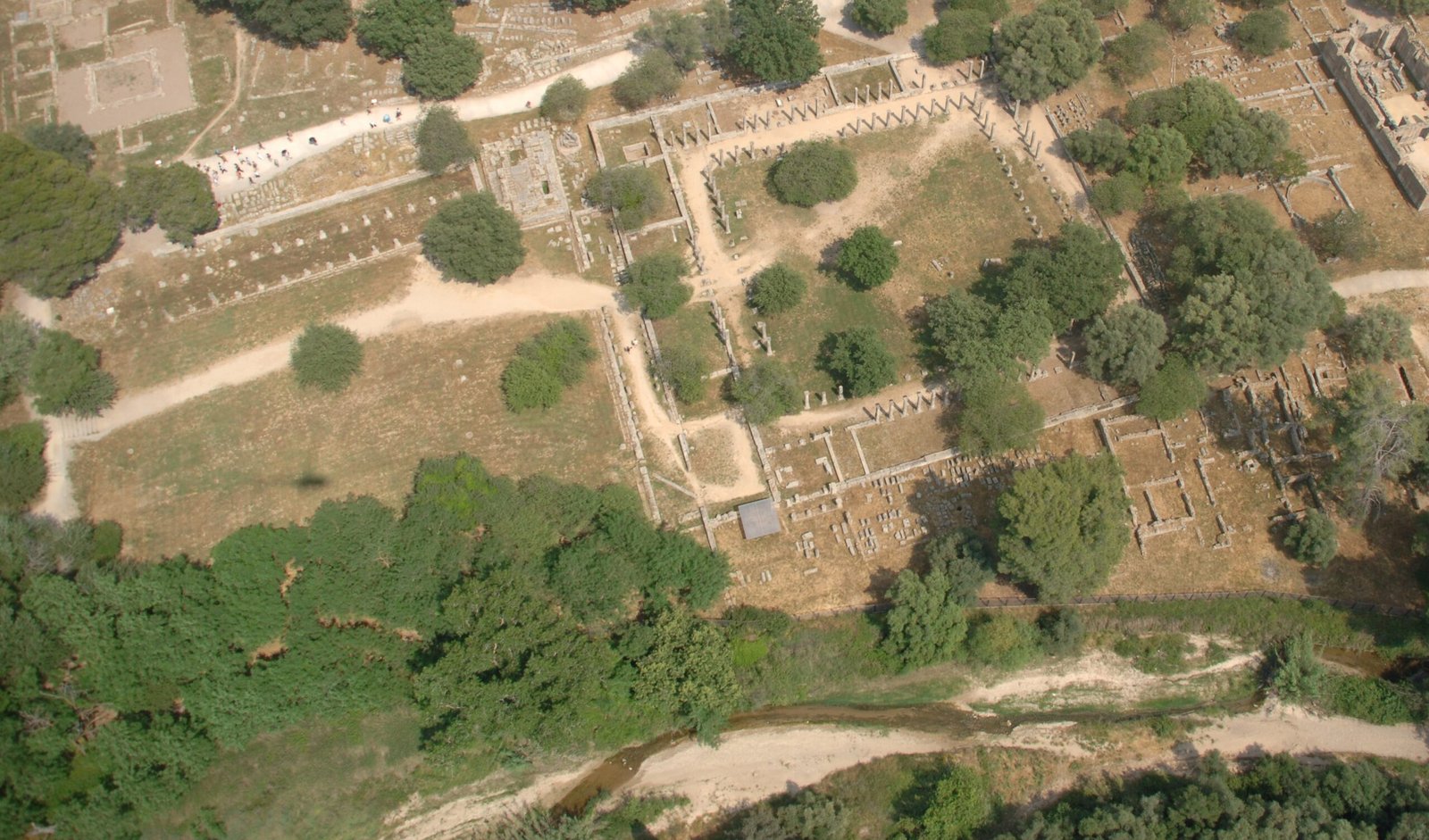
The Gymnasion of Ancient Olympia stands as one of the ancient world’s most significant and impressive athletic facilities. Erected during the Hellenistic period, specifically in the 2nd century BC, this vast, rectangular complex was purpose-built as the premier training ground for athletes preparing for the Olympic Games.
Situated in the flat area northwest of the sacred Altis and east of the Kladeos riverbed, the Gymnasion was indispensable for competitors, particularly those in running events and the pentathlon, which required expansive open areas.
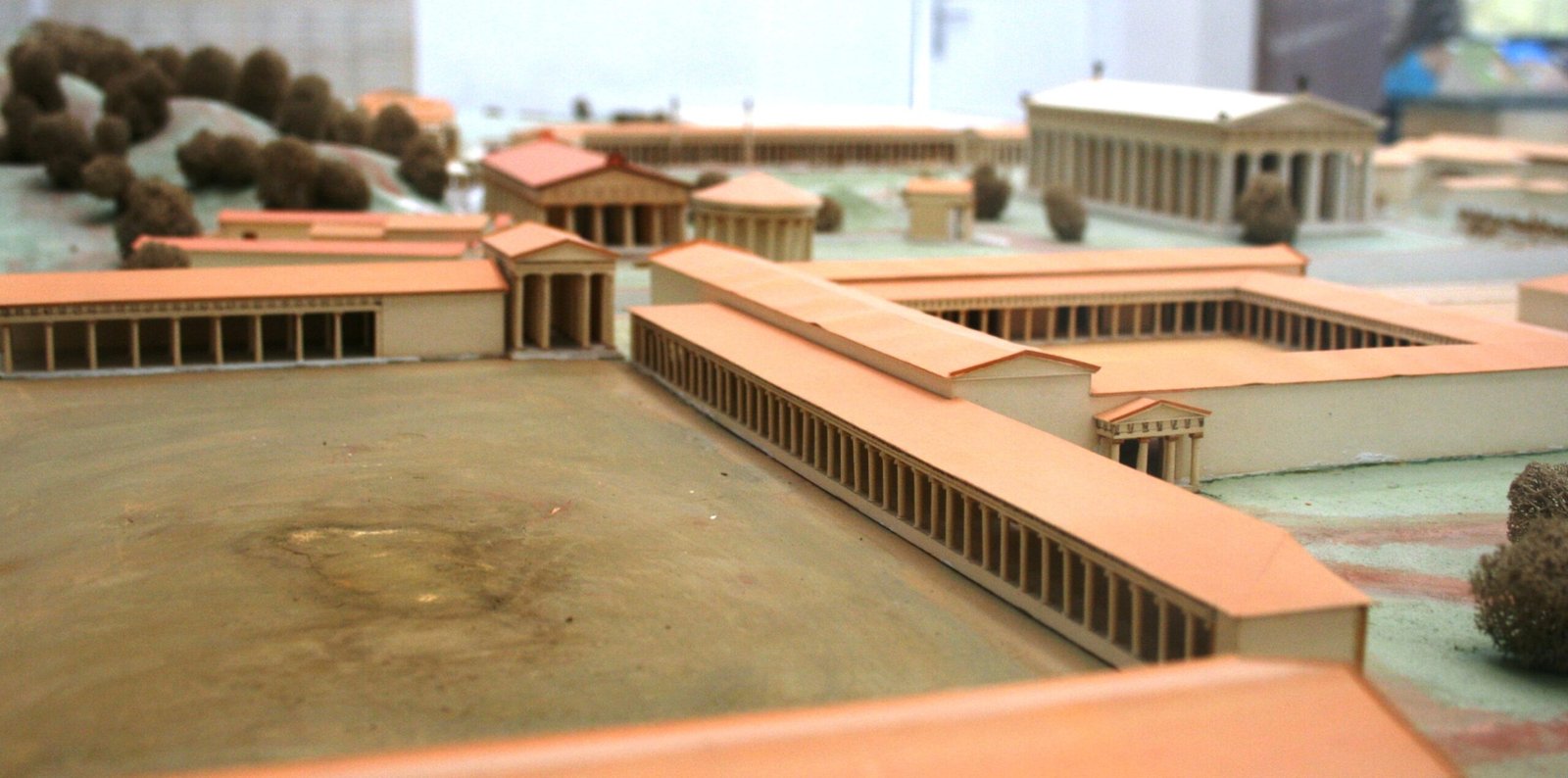
The architectural design of the Gymnasion was both practical and imposing, featuring a vast open courtyard surrounded by colonnaded porticoes that provided shade for athletes training during the hot
Greek summers.
The covered stoas along with the expansive central area offered sufficient space for practicing the various disciplines like javelin throw, discus, and long jump.
The design of the Gymnasion was both monumental and highly functional, demonstrating a sophisticated approach to athletic preparation.
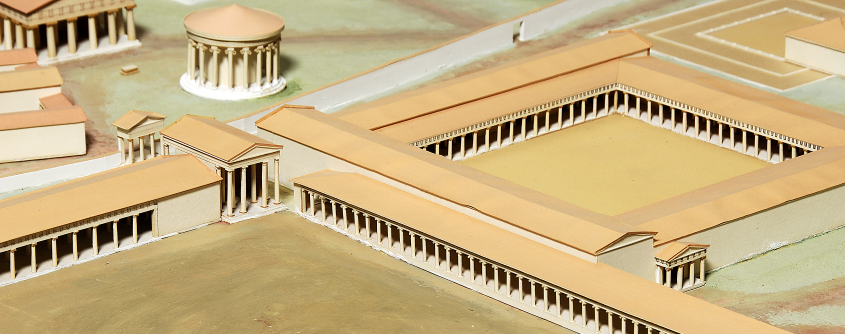
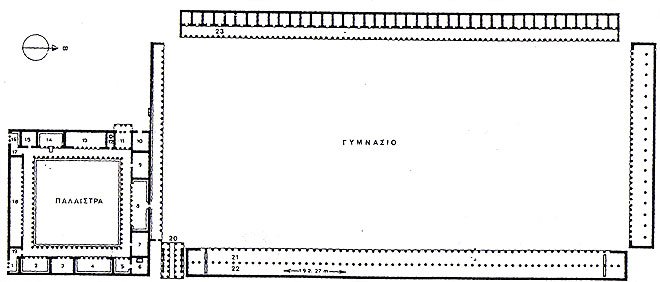
The structure, extending on a north-south axis, featured a massive central open-air courtyard surrounded by four colonnaded porticoes (stoas).
The overall size of the complex is remarkable: it reaches approximately 220 meters in length and 120 meters in width, covering a surface that exceeds 26 acres. This scale is similar to that of the Olympic stadium itself, emphasizing its importance as a rehearsal space.
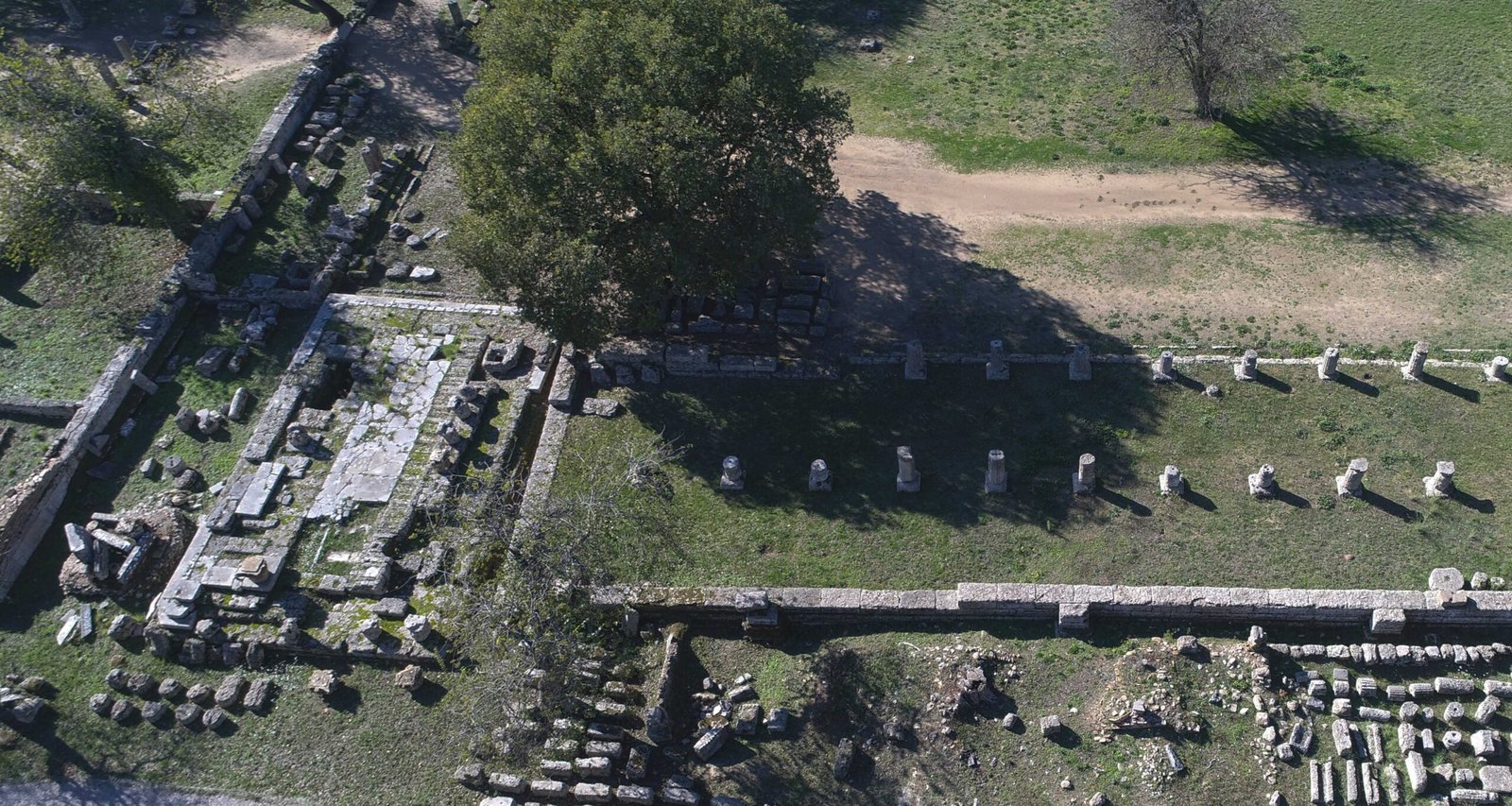
The porticos that flanked the large central courtyard were built gradually over time and were necessary to support the athletes’ preparation, so that it was not affected by the weather conditions.
The south portico of the Gymnasium was one of its initial structures, built in the early 2nd century B.C. This single-aisled portico featured an external colonnade facing the central courtyard (its order—Ionic or Doric—is debated). Notably, it was constructed right next to the Palaestra’s north stoa, sharing a back wall and connecting through an opening.
The east portico, constructed in the 2nd century BC, was particularly notable. It was double-aisled, facing the courtyard, and measured 212.05 meters long. This portico housed the xystos, a roofed track for training, paralleled by an open-air corridor called the paradromis. Its length was perfectly suited for practicing the stadion race, the prestigious sprint event. The expansive central courtyard provided ample space for other field events, such as the javelin throw, discus, and long jump.
The west portico, although most of it has been washed away by the Kladeos River, archaeologists believe that it consisted of a series of rooms that served as accommodations for athletes.
The Gymnasion of Ancient Olympia is a large Hellenistic training complex used by athletes preparing for the Olympic Games. It is an elongated, enclosed compound with covered stoas surrounding a central exercise area.
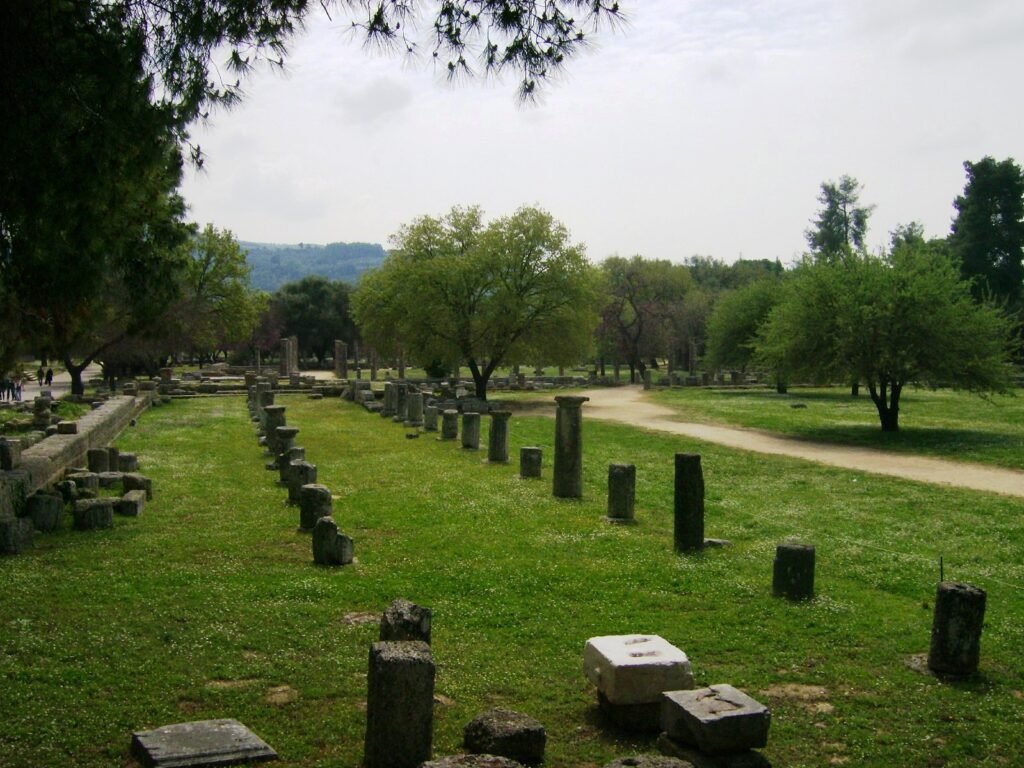
The surviving remains belong to a Hellenistic building phase (the visible structure dates mainly to the 2nd century BC), although athletic activity at the site predates the masonry remains.
Located northwest of the Altis and adjacent to the river Kladeos, the Gymnasion forms the main training complex together with the nearby Palaestra (wrestling school). The two complexes together served as the athletes’ preparation area.
The strategic location and design of the Gymnasion highlight its symbiotic relationship with the nearby Palaestra, which was situated to the south.
Together, these two buildings formed the complete training environment a few days/hours before the athletes’ competition in the official Olympic Games. This was preceded by forty days of equally hard preparation in the gymnasiums and the palaestra of Elis, the host city of the Olympic Games and the capital of Elis.
While the Palaestra focused on combat sports and training that required enclosed spaces (like wrestling and boxing), the Gymnasion catered specifically to the events demanding running tracks and open areas.
The monumental propylon of the Gymnasium was situated at the southern end of the complex. It was added between the 2nd and 1st centuries BC to monumentalize the entrance and establish a clear divide between the sacred Altis and the secular sports facilities.
Architecturally, it was designed in the Corinthian order and featured three passageways. Its stereobate was oriented toward the east, and its elaborate Corinthian columns served to highlight the prestige of the training grounds where track and pentathlon athletes prepared for the Games.
The complex suffered damage over the centuries; for example, the west portico have been washed away by floods of the Kladeos river in the 4th century CE.
Excavations by the German Archaeological Institute and, more recently (2013-2015), the Ephorate of Antiquities of Ilia have worked to uncover the foundations, wall sections, and architectural elements like column drums and a water drainage gutter, confirming the structure’s massive scale and architectural detail, including traces of painted decoration on the east wall.