The Olympic Council (Senate of the Eleans)


Composition and Political Evolution

The Olympic Council (Olympike Boule) was the supreme collective body of the city-state of Elis responsible for the administration and oversight of the sanctuary. It was composed of prominent citizens and initially possessed an oligarchic structure, consisting primarily of wealthy landowners. Following the synoikismos (unification) of Elis in 471 BC, the Council adopted more democratic characteristics, similar to those of Athens, while remaining the principal administrative and consultative body. While the exact number of members is not recorded for all periods, the discovery of a bronze ballot marked with the number 175 suggests the possible size of the body during the Roman era.

Seat: The Bouleuterion

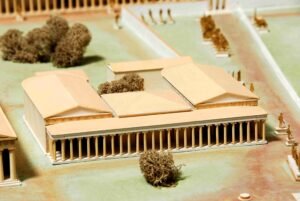
The seat of the Council was the Bouleuterion, located south of the Temple of Zeus, outside the sacred enclosure of the Altis. This complex served as an archive, housing official documents such as Elean laws, international treaties, proxeny decrees, and lists of Olympic victors. In this space stood the statue of Zeus Horkios (Zeus of the Oath), before which athletes, their relatives, and trainers took a sacred oath to compete honorably and follow the rules.

Responsibilities and Organization of the Games

The Council held exclusive responsibility for the general organization and supervision of the Panhellenic festival.
  • Election of Hellanodikai: The Council elected the Hellanodikai (Judges of the Greeks), whose number fluctuated between 2 and 12 depending on the administrative divisions of the Elean tribes. These judges underwent ten months of training prior to the games, instructed by the nomophylakes (guardians of the law) of Elis.
  • Enforcement of the Sacred Truce: The Council was the sole authority for the enforcement of the Olympic Truce (Ekecheiria). It had the power to impose heavy financial penalties on city-states that violated the truce, as occurred in 420 BC with Sparta, which was fined and excluded from the sacrifice and competitions for invading Lepreon.

Judicial Power and Penalties

The Council functioned as an appellate body for the decisions made by the Hellanodikai.
  • If an athlete believed they were unfairly judged, they could appeal to the Council. The Council had the authority to fine the judges if an error was proven, though the official declaration of the victor typically remained irrevocable.
  • It imposed fines for bribery or fraud. The revenue from these fines was used to commission the Zanes, bronze statues of Zeus erected at the entrance to the Stadium to serve as a public warning against cheating.
  • It possessed the right to declare a city “excluded” from the festival or to ban athletes from regions that failed to respect sacred laws.

Religious and Political Oversight

he Council supervised all religious ceremonies and, often in conjunction with the “Demos of the Eleans,” authorized the erection of honorary statues for benefactors or Olympic victors. Furthermore, it functioned as an international center for arbitration, resolving territorial or political disputes between other Greek city-states, such as a land dispute involving Xenophon in the 4th century BC